
Technical Sharing | High-Efficiency, High-Precision Face Milling Cutters: The Ideal Choice for Enhancing Quality and Productivity in Surface Machining
In modern machining, surface milling is one of the most widely used processes. Whether in automotive components, aerospace structures, or precision semiconductor equipment, surface quality directly impacts product performance and service life. In this critical operation, face milling cutters play a decisive role.
As a professional provider of precision tooling solutions, Shanghai Nagoya Precision Tools Co., Ltd. (hereinafter referred to as “SNSTC”) has developed extensive technical expertise in face milling cutters. This article outlines the key selection principles and demonstrates how SNSTC enables customers to overcome machining challenges through continuous technological innovation.
1.What is a Face Milling Cutter?
A face milling cutter is primarily used for machining flat surfaces. Unlike standard end mills, it features cutting edges on both the face and the periphery. The peripheral edges perform the primary cutting action, while the face edges ensure surface finishing quality.
Face milling cutters are characterized by high rigidity and stable cutting performance. With multiple teeth engaged simultaneously, they enable high material removal rates, making them a preferred choice for high-efficiency machining.
2.How to Select a Face Milling Cutter
In practical production, selecting appropriate tool parameters can significantly improve machining efficiency. The key factors for face mill selection are as follows:
①Diameter Selection
The cutter diameter should be selected based on the width of the surface to be machined. To ensure stable chip formation and reduce tool marks, the cutter diameter is typically slightly larger than the workpiece width, ideally 1.3-1.6 times the machining width. For large-area surfaces, where machine power or tool size is limited, multiple passes may be required.
②Selection of Lead Angle
The lead angle directly affects the distribution of cutting forces:
45° lead angle: The most versatile option, providing a balanced distribution of radial and axial forces; suitable for cast iron and general materials.
75° lead angle: Widely used, offering high cutting edge strength and good cost performance.
90° lead angle: Ideal for step surfaces and thin-walled parts, effectively reducing radial forces and minimizing workpiece deformation.
③Number of Teeth
Coarse-pitch cutters: Provide large chip space, making them suitable for heavy roughing and ductile materials.
Fine-pitch cutters: Allow lower feed per tooth and smoother cutting, making them ideal for finishing and thin-walled parts.
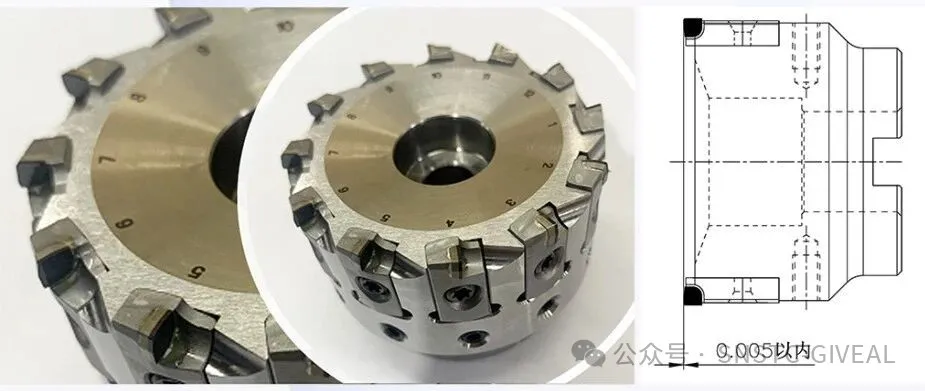
3.SNSTC PCD Face Milling Cutter: Ensuring High Precision
As manufacturing demands for efficiency and surface quality continue to increase, conventional carbide tools may no longer meet the requirements under certain conditions. In the machining of aluminum alloys, composite materials, and high-silicon materials, PCD face milling cutters—thanks to their exceptional hardness and wear resistance—have become an effective solution for improving both surface quality and productivity.
In response to these challenges, SNSTC has developed high-efficiency, high-precision PCD face milling cutters.
4.Key Advantages
① Exceptional Positioning Repeatability: SNSTC face milling cutters feature a quick-change insert holder system, enabling repeatable positioning accuracy within 0.005 mm. In practice, operators can quickly resume machining without complex adjustments or re-setting, significantly reducing downtime.
② Superior Surface Finish: Thanks to highly controlled runout accuracy, each insert follows a consistent cutting path. This not only extends tool life but also ensures a uniform and high-quality surface finish on the workpiece.
③ Customized Solutions: For industries such as new energy vehicles and semiconductors, SNSTC provides turnkey solutions. For example, in the machining of motor housings and stainless steel valve blocks, SNSTC offers not only standard cutting tools but also customized non-standard PCD face milling cutters tailored to specific material properties and machining challenges, ensuring efficient and stable performance.
5.Conclusion
Although face milling cutters are fundamental tools for surface machining, their technical complexity should not be underestimated. With over 30 years of expertise in precision tooling, SNSTC continues to drive productivity through innovation. Whether it is high-performance PCD face milling cutters or customized solutions for special applications, SNSTC is committed to delivering more efficient, precise, and stable machining performance.
If you are facing efficiency bottlenecks or surface quality challenges in your machining processes, it may be worth re-evaluating your face milling cutter selection.